How Much Is One Missed New Patient Call Really Worth to a Dental Practice?
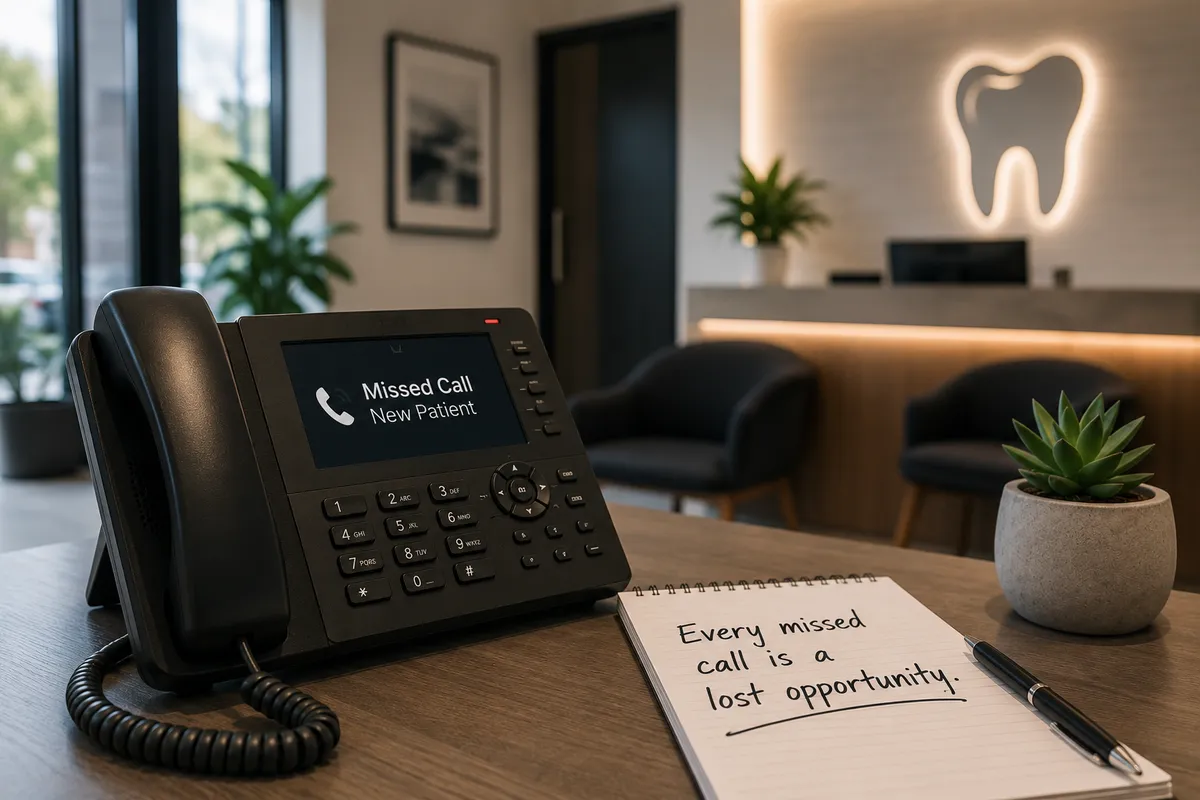
A new patient calls your office at 10:17 on a Tuesday morning.
Nobody answers.
They don't leave a voicemail.
At 10:19, they call the next dentist.
That office answers.
They schedule.
Your practice never knows the patient existed.
I've talked about missed calls before because I know they're one of the easiest ways for a practice to lose money without realizing it.
But let's take this a little further.
What was that call actually worth?
It wasn't just an exam and cleaning.
Let's Follow That Patient
Let's keep the math simple.
A new patient comes in for an exam, X-rays and cleaning.
Over the next several years, they have regular hygiene visits.
Eventually they need a crown.
Maybe a filling.
Maybe periodontal treatment.
At some point they decide to whiten their teeth.
Nothing unusual, just a pretty normal dental patient.
Let's say that patient generates an average of $1,200 a year for the practice.
If they stay five years, that's $6,000.
Now imagine they bring their spouse into the practice.
Then one of their children.
Or they refer a coworker.
Suddenly that original phone call wasn't worth $200 or $300.
It may have been worth $10,000, $15,000 or considerably more over time.
And you never knew you lost it.
Now Let's Make the Math More Uncomfortable
Suppose your practice misses five legitimate new-patient opportunities each month.
If each of those patients represents even $5,000 in lifetime value, that's:
$25,000 in potential patient value each month.
Sixty missed opportunities over a year would represent:
$300,000 in potential lifetime patient value.
At ten missed opportunities a month, that number becomes:
$600,000.
Obviously, not every caller would have scheduled. and not every patient would have stayed five years and not every patient would have needed significant dentistry.
That's not the point.
The point is that a missed new-patient call can be worth a lot more than most practices assign to it.
If they assign anything to it at all.
It Gets Worse If You’re Paying for the Call
This is the part that really gets me.
Let's say you're spending $5,000 a month on marketing.
SEO. Google Ads. Social media. Website.
Whatever you're doing.
The marketing works.
Someone sees you.
They check your reviews.
They visit your website.
They decide they like what they see.
They finally pick up the phone.
And nobody answers.
You just paid to create an opportunity for the dentist down the street.
That's a pretty expensive way to market your competitor.
Answering the Phone Is Only the First Number
There's another problem if I may.
A practice can answer 100% of its calls and still lose a lot of opportunity.
The phone gets answered:
“Thank you for calling Dr. Smith's office. How can I help you?”
Great.
Then the potential patient says:
“I'm looking for a new dentist. Do you take Delta?”
The team member says:
“No, we're out of network.”
“Okay. Thanks.”
Click.
Technically, the call was answered.
The opportunity was still lost.
Or someone calls with a toothache.
The first available appointment is three weeks away.
Or the caller asks about implants and gets:
“Yeah, the doctor does those. You'd have to come in for a consultation.”
No conversation.
No questions.
No reason to choose the practice.
So I wouldn't only want to know how many calls are being answered.
I'd want to know what happens to them.
There Are Five Numbers I’d Want to Know
If I owned a dental practice, I'd want these numbers every month:
How many incoming calls did we receive?
How many calls did we miss?
How many were legitimate new-patient opportunities?
How many of those patients scheduled?
How many actually showed up?
That gives you a very simple funnel:
Opportunity to Answered to Scheduled to Arrived
Most practices know the last number.
“How many new patients did we get this month?”
That’s useful.
But it doesn’t tell you how many you could have had.
Here's Where It Gets Really Interesting
Imagine two practices each report 40 new patients this month.
Sounds identical.
But Practice A received 50 legitimate new-patient calls and scheduled 40.
Practice B received 80 and scheduled 40.
Same new-patient number.
Completely different performance.
Practice A converted 80% of its opportunities.
Practice B converted 50%.
If you're the dentist in Practice B and you only see “40 new patients,” you might decide you need more marketing.
You don't.
You already have more opportunity than Practice A.
You're just losing half of it.
Before Spending Another Dollar
This is why I think dentists should understand their phone numbers before automatically increasing their marketing budgets.
If you're generating plenty of calls and converting poorly, buying more calls doesn’t solve the problem.
It makes the problem more expensive.
Listen to some calls.
Look at when calls are being missed.
Find out why potential patients aren’t scheduling.
Look at how quickly missed calls are returned.
Pay attention to what happens when someone asks about insurance, fees, availability or a specific procedure.
You may discover that your marketing is doing exactly what you’re paying it to do.
The problem is happening after the phone rings.
And that’s actually good news.
Because that’s something you can control.
Before you spend more money trying to make the phone ring, make sure you know what happens when it does.
Schedule here.